
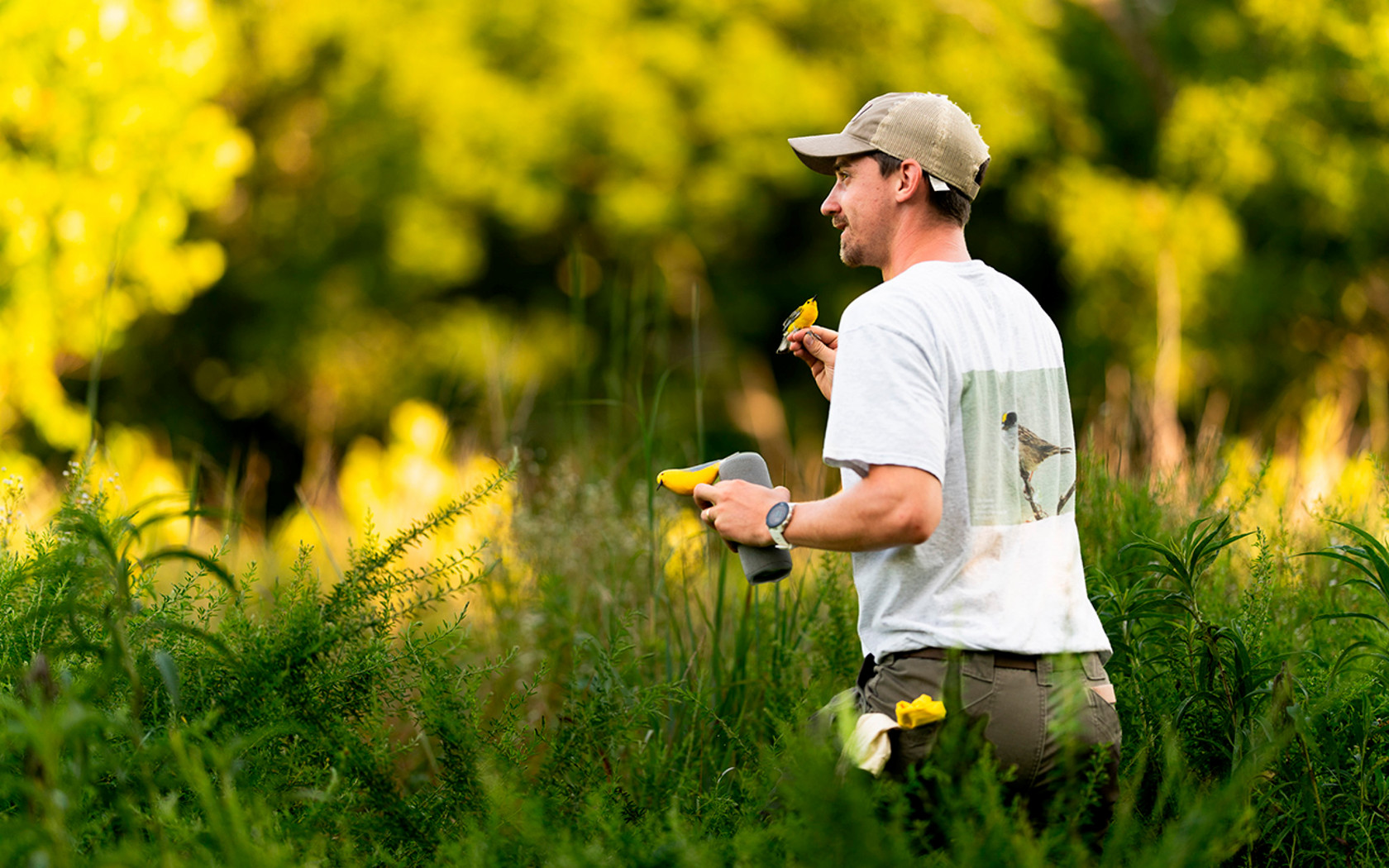
On June 13, 2025, a bird weighing no more than half an ounce — one that easily would fit into the palm of your hand, with your fingers curled around him — left Kansas City headed south.
His name was Hydrogen.
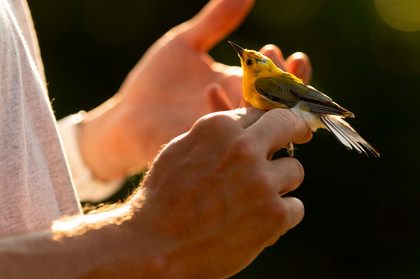
Had he been low enough to observe from the ground, birders with binoculars would have spotted him right away: a Prothonotary Warbler, bright golden yellow with blue-gray wings and a larger than average beak.
By September, he had reached Mississippi and crossed the Gulf of Mexico, spending more than a month in Mexico, Honduras, and Nicaragua before arriving in Bolivar, Colombia in late October.
There, the bird would enjoy mild weather and plenty of available food until April when he headed north again, making it to the Gulf of Mexico by the end of the month. By May 3, he was back to the same nestbox he used the previous year.
It’s impossible to know all that he saw and experienced in those 5,000 miles.
Scientists do, however, know his exact route. He was wearing a tiny but powerful geolocator; like the black box in an airplane, it captured his flight data.
It had been attached by Pitt State Biology graduate student Gabe McClain, who caught him at Wyandotte County Lake in a delicate net and measured and weighed him before attaching it with a tiny harness.
McClain, who is from Blue Springs, Missouri, and most recently, Joplin, Missouri, is working with his advisor, Associate Professor Andrew George, and two Audubon chapters to conduct a research project that is the first of its kind in the region. Also helping: the Johnson County K-State Extension Master Naturalists.
“Their migration hasn’t been studied here, and this is a very expansive, collaborative study because of the number of partners and volunteers, making it unique,” George said. “It’s privately funded and very grassroots.”
Migrating westward
Prothonotary Warblers (PROWs) are cavity nesters, relying on nests inside trees or on nesting boxes to successfully reproduce. In recent decades, their populations in their native southeastern United States declined with the clearing of forests.
Their breeding range has made its way to the Pittsburg area, which is surrounded by thousands of acres of Mined Land Wildlife Areas owned and managed by the State of Kansas.
In the past few years, they have been found repeatedly,” George said. “Their populations overall are declining — most songbirds are — but in this area, they’re actually increasing.”
McClain and George are studying what’s contributing to that increase.
Box by box
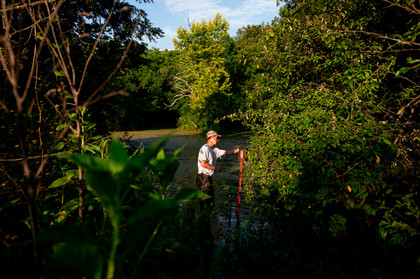
McClain’s project, started in 2025, spans 12 sites in Southeast Kansas, a few in Southwest Missouri, and several in Northeast Kansas; altogether, there are 212 nesting boxes.
He and members of Sperry-Galligar Audubon — a chapter named after two former Pitt State Biology professors — built and installed them on public and private land in Cherokee, Crawford, Labette, and Montgomery counties in Kansas and in Jasper County in Missouri.
In the Kansas City area, the project is supported by many active members of Burroughs Audubon, who monitor the boxes on private property and at Wyandotte County Lake, and scout for bird sightings with binoculars and scopes.
"We have a lot of people invested and connected, and a lot of landowners excited about it,” McClain said. “We have a great support system from a network of dedicated people. This project wouldn’t exist without them.”
Also helping with the project are two undergraduate students, Caleb Stradley from Pittsburg and Owen Long from Basehor, Kansas.
Bird by bird
If all goes well, two more PROWs caught, banded, and equipped with geolocators on a hot July day just west of Pittsburg also will make the trip that Hydrogen did.
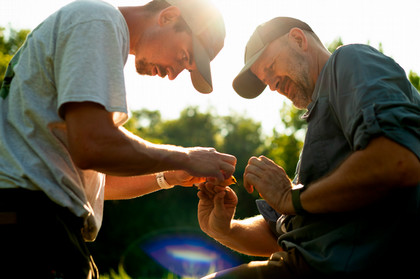
“Our goal is to capture migration data,” McClain explained as he attached a metal band with a unique 9-digit number to the tiny leg of the first bird — a male — from his truck tailgate on a gravel road in Mined Land Wildlife Area 5.
As McClain read aloud measurements like weight and wingspan, George recorded it in a growing log of data.
On the bird’s legs, McClain attached three plastic bands in unique colors.
“That’s so you can see with binoculars which bird you’re looking at,” McClain explained. “Each bird gets a unique three-color combination.”
The process is tedious.
On this day, McClain and George arrived at the Mined Land Area at dawn to check several of the 31 nesting boxes. By 9 a.m., they had caught, banded, and released two birds.
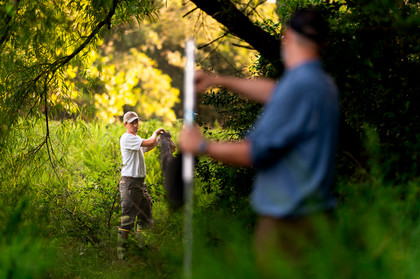
To capture the male, George first cleared a waist-high area with a weed eater. McClain then set up a 25-foot-long mist net, adding a small blue-tooth speaker and a decoy in an attempt to lure in a male they knew was nearby; his mate was incubating their second clutch of eggs in a nest box a few yards away.
“This guy gets a green and yellow on one leg, and an orange and silver band on the other,” McClain said as he worked. “We know looking at his feathers, his coloration, that he’s older than two years — so he has survived at least two migrations to South America.”
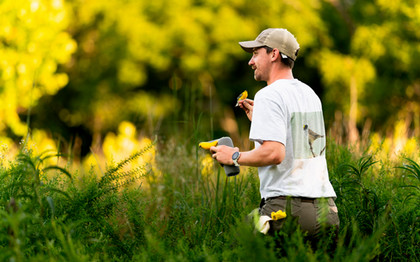
McClain caught the female at the nesting box using a small bright gold bag — the same color as the bird — and used the same process at his tailgate.
Last year, the McClain and George banded 74 nestlings and 59 adults. Of those, they released six birds wearing geolocators and retrieved three — one was Hydrogen, one called Mulberry came from Wilderness Wetlands in Johnson County, and the other one was retrieved from property owned by retired Pitt State Biology professors Steve and Cindy Ford in Crawford County. Data is still being extracted and analyzed.
In 2026, they put out 36; in 2025 they put out six; and in 2024 they put out one. — half in Southeast Kansas and half in the Kansas City area — thanks to a private donation and a partnership with Louisiana State University.
“If we get 30 percent of our geolocators back, that’s great,” George said. “If we even get one back, it tells us so much.”
By mid-July this year, they’d banded more than 117 nestlings and 50 adults.
Being at Pitt State
McClain said he could not have found a better university in the Midwest for his master's degree focus.
“There are very few professors who commit the time and energy to understand so many wildlife systems. Dr. George is a true naturalist — he wants to learn about all he can possibly learn about in the natural world,” McClain said. “And for the size of this university, there is an impressive support system of getting graduate students what they need for projects like this.”
He will graduate in December with the goal of going into wildlife or land management, but plans to continue monitoring the boxes next spring and summer.
George hopes to find a funding stream to allow the project to continue for future students.
It is the students, he said, that makes him happy to be at a university the size of Pitt State.
“I’m all about mentorship, about being with the students – I find it very fulfilling. I can’t imagine doing anything else,” George said. “I love these animals too – whichever species it is we’re studying. It's fascinating to me. I love learning about them, thinking about where they go. But just as important is that I love being with students in the field, seeing them learn and grow. And then seeing them go on to get jobs with the state or with national agencies, at a higher level. It’s a lot of fun.”
Learn more about Pitt State Biology: