
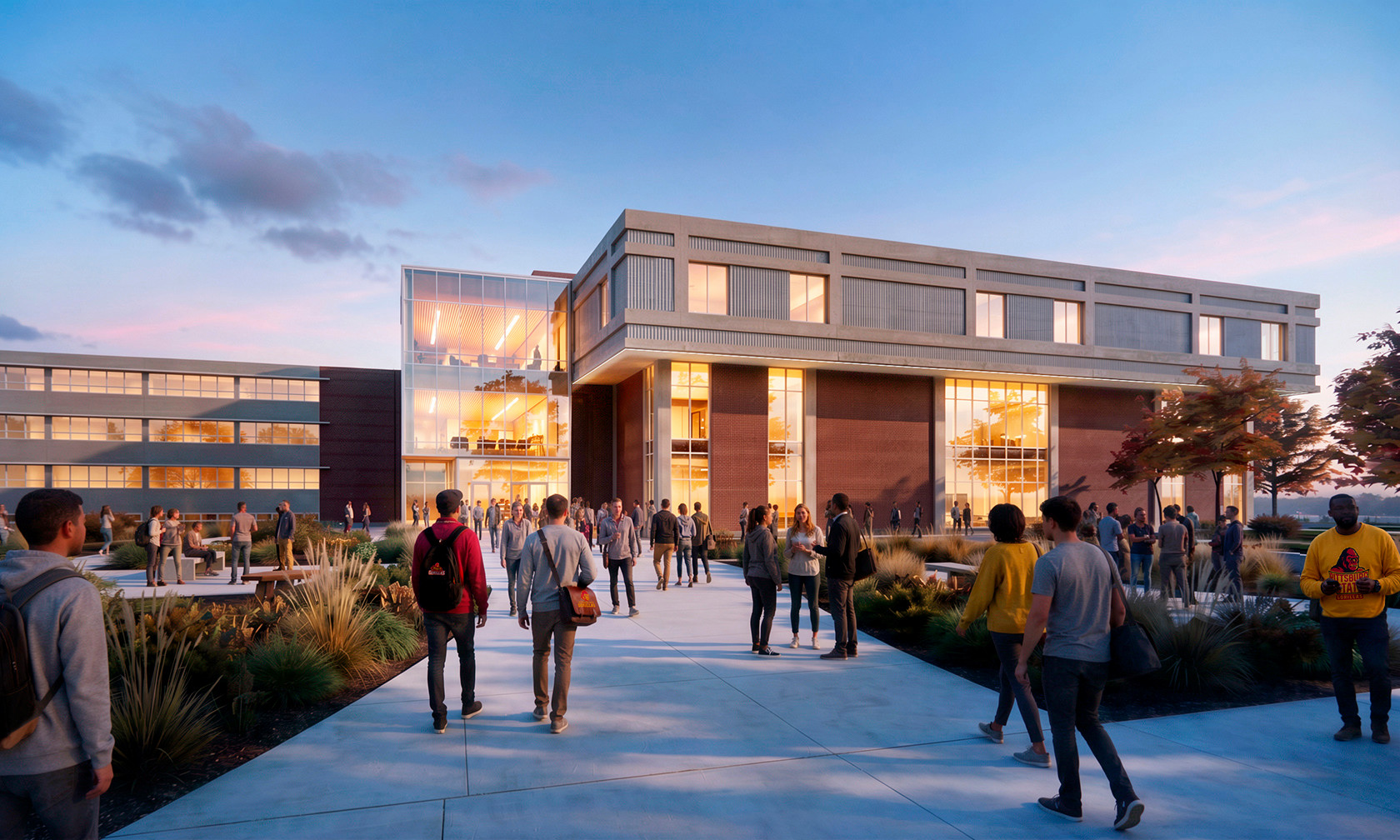
Pittsburg State University's comprehensive capital campaign will include the renovation and modernization of two adjoining science buildings, Heckert‑Wells Hall and Yates Hall, representing a $53 million investment in students, the university, and the region.
The multi‑phase project will transform facilities that serve nearly every Pitt State student and are foundational to high-demand programs in science, healthcare, technology, mathematics, and cybersecurity.
“Our programs have evolved dramatically since the 1960s and 1980s, when the facilities were constructed,” said Chris Childers, dean of the College of Arts & Sciences. “Our facilities have not — and it’s time to close that gap.”
Design work already is underway, thanks to seed money from a federal science, technology, engineering, and math (STEM) infrastructure initiative. Additional fundraising has begun. Work is planned to begin in 2026 and will be completed in phases through 2030.
“Heckert‑Wells and Yates are central to the Pitt State experience,” said President Thomas Newsom. “Nearly every student passes through these buildings, and for students pursuing STEM careers, their future begins here. This project ensures our facilities match the quality of the education we deliver and the workforce needs of our region.”
Buildings from another era
Yates Hall was built in 1963 and houses Mathematics, Physics, and Computer Science. Heckert‑Wells Hall, built in 1984, is home to Biology and Chemistry. Combined, the buildings total more than 106,000 square feet.
While faculty have excelled in educating students within these spaces for decades, the bulk of the classrooms, laboratories, and infrastructure remain largely unchanged since the buildings opened — some casework still dates back to Carney Hall, the science building and auditorium demolished in 1979.
“Students now arrive at Pitt State from high schools with laboratory facilities that exceed the quality of those currently available on campus,” said Childers. “Faculty are teaching modern curricula in spaces designed for a different era, and the limitations of the facilities have become increasingly apparent.”
Supporting students and the workforce
Nearly every Pitt State student enrolls in courses taught in Heckert‑Wells or Yates as part of general education. Students majoring in Biology, Chemistry, Mathematics, Physics, and Computer Science use these facilities throughout their academic careers, as do students in numerous other majors.
Demand for healthcare professionals continues to grow across the region. While Pitt State’s Nursing facilities feature state‑of‑the‑industry simulation labs, the science labs that support students in Nursing, as well as students in Pre-Medicine, Pre-Physician Assistant, Pre-Physical Therapy, and Medical Laboratory Sciences are lacking, Childers said.
At the same time, emerging and expanding programs such as Computer Science, Cybersecurity, Artificial Intelligence, and Materials Science require specialized teaching and research spaces that did not exist when these buildings were built. The Computer Science Program — just three years old — already has exceeded enrollment projections, with continued growth anticipated.
The renovation also will support Pitt State’s commitment to science education, Childers said. Kansas faces a critical shortage of STEM educators, and future teachers must be prepared to teach and inspire students in modern laboratory settings.
Project scope
The renovation will modernize and optimize Heckert‑Wells and Yates for:
- • A dedicated Computer Science and Cybersecurity Lab
- • Updated STEM classrooms and teaching labs
- • Specialized research space
- • Enhanced facilities for Chemistry, Physics, Materials Science, and interdisciplinary work
- • A new central connector between the two buildings to promote collaboration across STEM disciplines
For each phase of the project, university leaders and architects will work closely with faculty and staff focus groups to ensure spaces are designed around the specific instructional and research needs of each discipline.
Funding and investment
The project represents a significant investment in Southeast Kansas and is supported by a diverse funding strategy that includes university, state, federal, and private funds.
“This is critical infrastructure for Pitt State and Kansas, and is therefore a priority for us and our partners in DC and Topeka,” Newsom added. “This support enables us to reduce our private fundraising needs to $20 million, which speaks to the important role this project has in the future of our region.”
Timeline
Design work has begun on early project phases, including creation of the Computer Science and Cybersecurity lab in Yates, projected to be complete in Summer 2027.
When fully completed in Fall 2030, the renovated science complex will provide modern, flexible, and collaborative spaces designed for 21st‑Century learning and career preparation.
“This project is about more than buildings,” Newsom said. “It’s about student success, regional workforce development, and ensuring Pitt State continues to prepare graduates for the careers and challenges of today and tomorrow.”
For more information about supporting this project, contact Mary Jo Dancer at mdancer@pittstate.edu or 620-235-6127.