
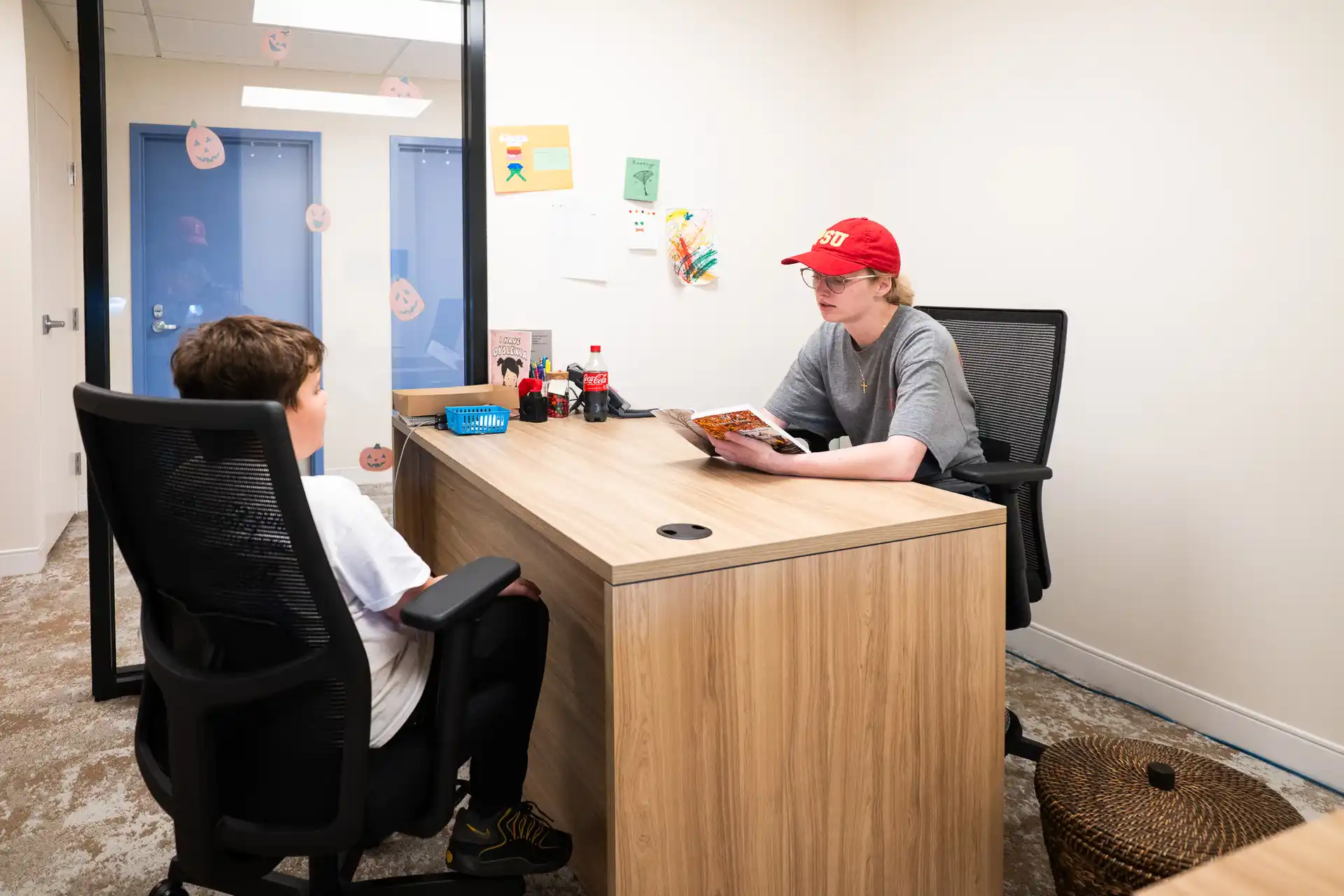
When Maddix Small was in second grade, reading felt like an insurmountable obstacle.
Today, the 20-year-old is pursuing a degree in Plant and Soil Science at Oklahoma State University, preparing for a career as an agronomist, and hoping to bring new knowledge back to his family’s farm and ranch operation in Neodesha, Kansas.
Maddix and his mother, Nicole Small, said a turning point that helped make that journey possible was Pittsburg State University’s Center for Reading.
Since 1996, the center has provided support for children and adults facing reading challenges.
This fall, it moved from campus into a new, more accessible location on the first level of the renovated and reopened Besse Hotel in downtown Pittsburg.
There, Executive Director David Hurford, founder, and his team are continuing to provide evaluations, science-based interventions, and advocacy services to individuals with dyslexia and other reading difficulties on a case-by-case basis, just as they have since Maddix was a child.
The center’s work is based on Hurford’s research examining why some children struggled to learn to read while others did not. That research led to methods to identify children who were at risk or struggling and to help them become competent readers. And, he realized, all students — not just those with dyslexia — could benefit from approaching reading as if it were a code linking sounds with their letters.
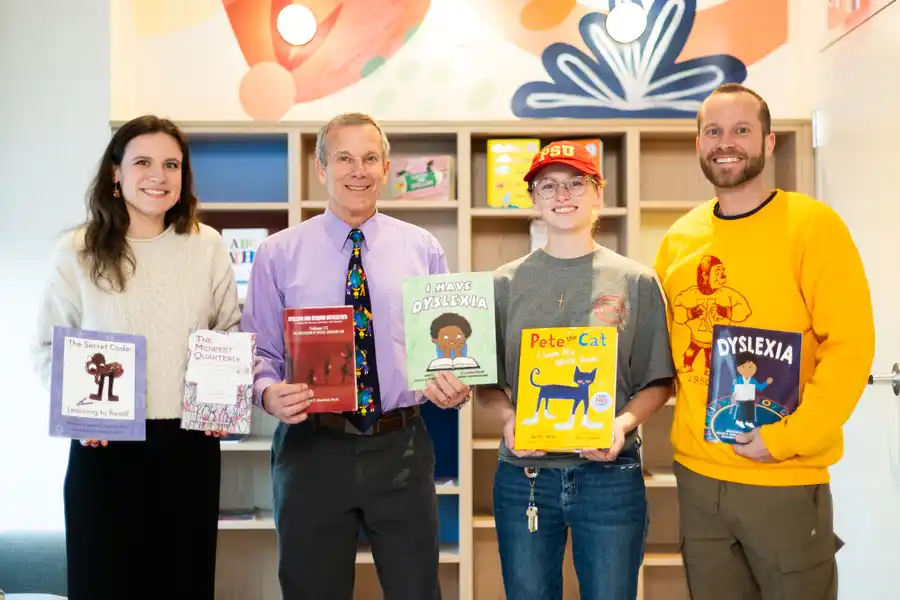
Hurford, now considered a national expert, has been appointed to task forces and consulted by visiting governors. This fall, he was chosen for a prestigious Margaret Byrd Rawson Lifetime Achievement Award by the International Dyslexia Association for his impact and reach.
A daily struggle
For the Small family, the impact was life changing. At the time, Maddix was reading at a kindergarten level while his classmates were reading at a second-grade level or higher.
“Where it hit me hard was word problems in math. I knew how to do math, I could do the worksheets with the math problems on them, but I couldn’t decipher what they were trying to ask in the word problems,” Maddix recalled. “I’d spend an hour and a half working on math homework, still wouldn’t have it done, and then would talk to friends in class and they said it took them 15 minutes. That really affected me.”
For Nicole, watching her son struggle was heartbreaking.
“It was very frustrating,” she said. “He cried every morning.”
That changed when the family’s babysitter, a Pittsburg State Education major, connected them with the Center for Reading.
Nicole remembers meeting with Hurford, who helped put a plan in place and appointed the babysitter to be Maddix’s tutor using the center’s proven methods and strategies.
“We went to campus several times, and then we began going through it at home with her,” Nicole said. “She brought him up to grade level by the end of the summer. It was a drastic jump.”
For Maddix, one memory stands out.
“At one point, I remember starting to read chapter books and how neat that was,” he said.
Nicole remembers that moment, too.
“I have pictures of him reading to his dog,” she said. “I was in tears watching that. Before, getting him to do any reading was like pulling teeth.”
Providing the tools
The diagnosis and support gave the family more than improved reading skills. It gave them a framework for understanding how Maddix learned and what tools could help him succeed.
“Once you get the diagnosis, it doesn’t define who he is, but rather it gives him the keys to decipher the world,” Nicole said.

Like many people with dyslexia, Maddix still encounters challenges. Even now, as a college student tackling advanced science courses, language processing can be difficult.
“I had a talk with one of my professors just this morning about how I can’t quite understand what he’s asking in his questions,” Maddox said. “I understand the material. But I can’t decipher what he’s asking. The thinking aspect is part of dyslexia. But now, I know to have those conversations with people, to explain that I might need an accommodation, and then I will be able do it.”
A success story
Maddix graduated from Manhattan Virtual High School in 2024 and earned an associate degree from Redlands Community College in May 2026. This fall, he began classes at Oklahoma State University, where he is studying Plant and Soil Science, and co-founded MAD Cattle Company with his brother, Dexter.
His goal is to become an agronomist on the family farm, 2S Land & Cattle, a sixth-generation cattle ranch and crop farm near Neodesha in southeastern Kansas.
Along the way, Maddix has built confidence not only as a student but also as a leader. He serves on the American Junior Maine Anjou Association and has become active in a way that would have felt out of reach when he was a struggling young reader.
“When I was little, I was very awkward, still am a bit,” he said. “But being able to blend with people is important, and I feel like this has helped me do that. There are all sorts of things, life wise, that I would not be where I’m at without tutoring.”
His mother agrees.
“I don’t think he’d be in college,” Nicole said.
Maddix didn’t hesitate to answer.
“I don’t think I would be either.”
Contact the Center
If someone you know is struggling to read, visit pittstate.edu/ece/reading-center.html to learn more.