

Accreditation has been renewed through 2032 for five Engineering Technology programs and the Construction Management program at Pittsburg State University by two commissions that are part of ABET — a nearly 100-year-old national accrediting organization.
The accreditation recognizes the quality, relevance, and continuous improvement of the university’s programs.
Renewed by the Engineering Technology Accreditation Commission (ETAC) of ABET:
- • Construction Engineering Technology
- • Electronics Engineering Technology
- • Manufacturing Engineering Technology
- • Mechanical Engineering Technology
- • Plastics Engineering Technology
Renewed by the Applied & Natural Science Programs Commission (ANSAC) of ABET:
- • Construction Management Program
All are part of the Crossland College of Technology in the Crossland Technology Center. The accreditation extends through 2032.
What is engineering technology?
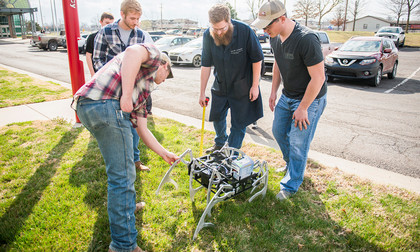
Engineering technology is sometimes misunderstood as being the same as engineering, or as being less rigorous.
“In reality, engineering technology is a distinct academic engineering career discipline that combines a strong foundation in mathematics, science, and engineering principles with project management, supervision, and production applications with extensive hands-on learning,” said Dean of Crossland College of Technology Lisa A. Riedle.
Engineering technology programs emphasize implementation, operation, testing, manufacturing, problem-solving, and continuous improvement in real-world settings.
At Pitt State, students may choose from five distinct paths in engineering technology (Construction, Electronics, Manufacturing, Mechanical, or Plastics), depending on their career goals.
What is construction management?
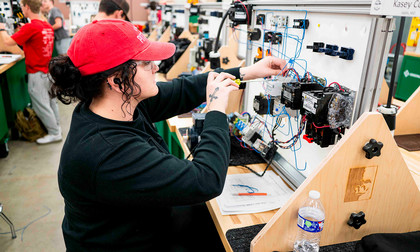
Construction Management is professional planning, coordination, and oversight of a construction project from start to finish, ensuring it is completed safely, on schedule, within budget, and according to quality requirements. Construction managers oversee resources, schedules, contracts, communications, and project teams throughout the building process.
At Pitt State, students may choose from three emphases areas (Safety Management, Field Management, or Company Management) depending on their career goals.

What this means for students and employers
For students and families exploring college options, accreditation serves as an independent review process that evaluates academic programs against nationally recognized standards.
For employers, it provides additional assurance that graduates possess the knowledge, skills, and preparation needed for today's workplaces.
"ABET accreditation tells our students and the industries that hire them that these programs have been measured against rigorous national standards," Riedle said. "Just as importantly, it requires us to continually examine what we teach and how well we prepare students as technology and industry evolve."
Advisory boards, employer partners, alumni, faculty, and students all play a role in helping programs remain relevant as technologies, business practices, and workforce demands continue to change.
"This is an important validation of programs that have been central to Pitt State's identity and mission for generations," said President Thomas Newsom. "Our responsibility is to prepare graduates who can take what they learn here and use it to solve real problems, strengthen companies, and help communities prosper. These programs do exactly that."
Applied learning
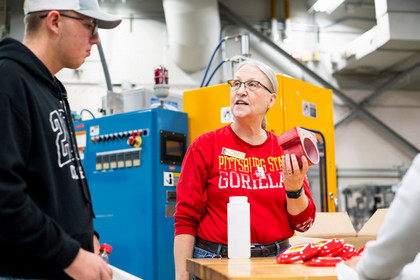
At Pitt State, students spend significant time working in laboratories using industry-standard equipment and process and production environments. From Day 1, they apply classroom concepts to practical challenges.
The model aligns closely with workforce needs across manufacturing, construction, industrial operations, automation, product development, plastics processing, and other technology-driven industries that rely on graduates who can bridge technical knowledge and practical application.
"Employers need graduates who understand the principles behind their field, but they also need people who can walk into a laboratory, manufacturing facility, or job site and put that knowledge to work," said Provost Susan Bon. "That combination of academic rigor and hands-on learning is a hallmark of a Pitt State education."
Learn more: