Community
Academics
Campus
Gorilla Rising

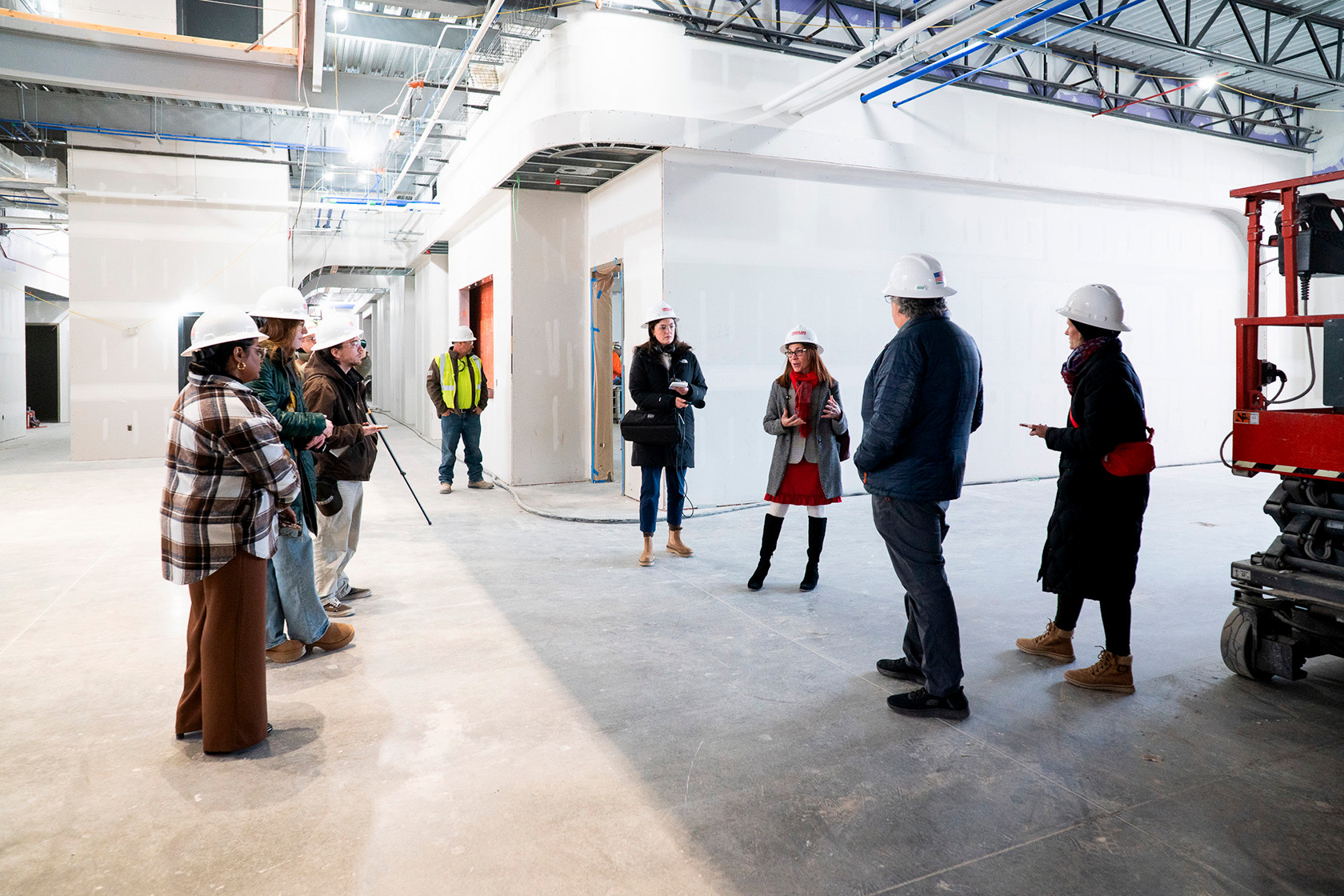
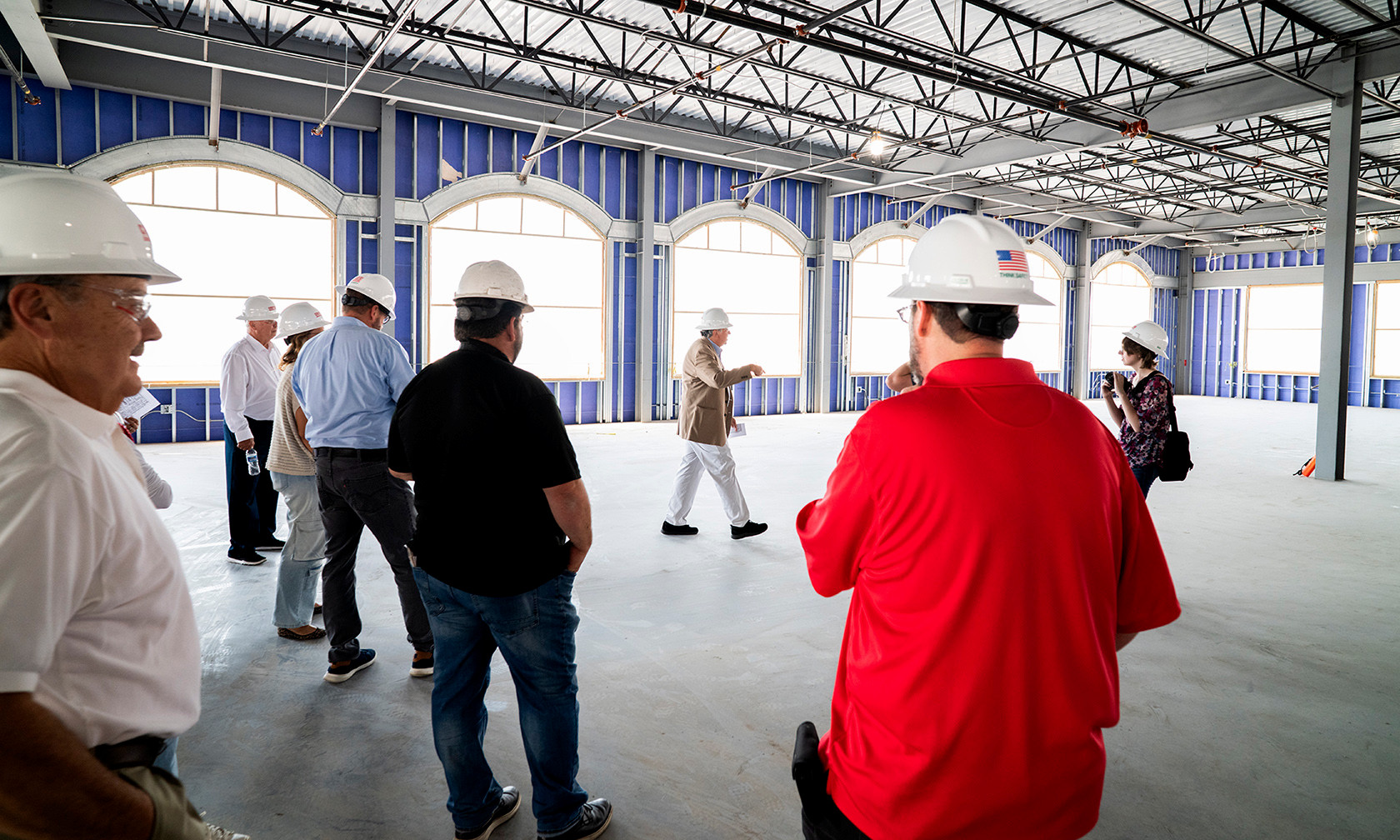
Numerous city, county, and state leaders and elected officials joined alumni, PSU Foundation trustees, Kansas Board of Regents representatives, faculty, staff, students, and community members for the celebration and for tours of both buildings.
The two projects represent the power of partnership, innovation, and investment in the future of Pittsburg.
Long recognized as one of the nation's leading business schools, the Kelce College of Business had outgrown the limitations of its former home. The building on campus was constructed in 1951 as the College High Laboratory School, where education students completed practicum teaching experiences.
“It no longer met the needs of a modern business education. Collaboration spaces were limited, technology integration presented challenges, and opportunities to host conferences and guest speakers were constrained,” said Dean Paul Grimes.
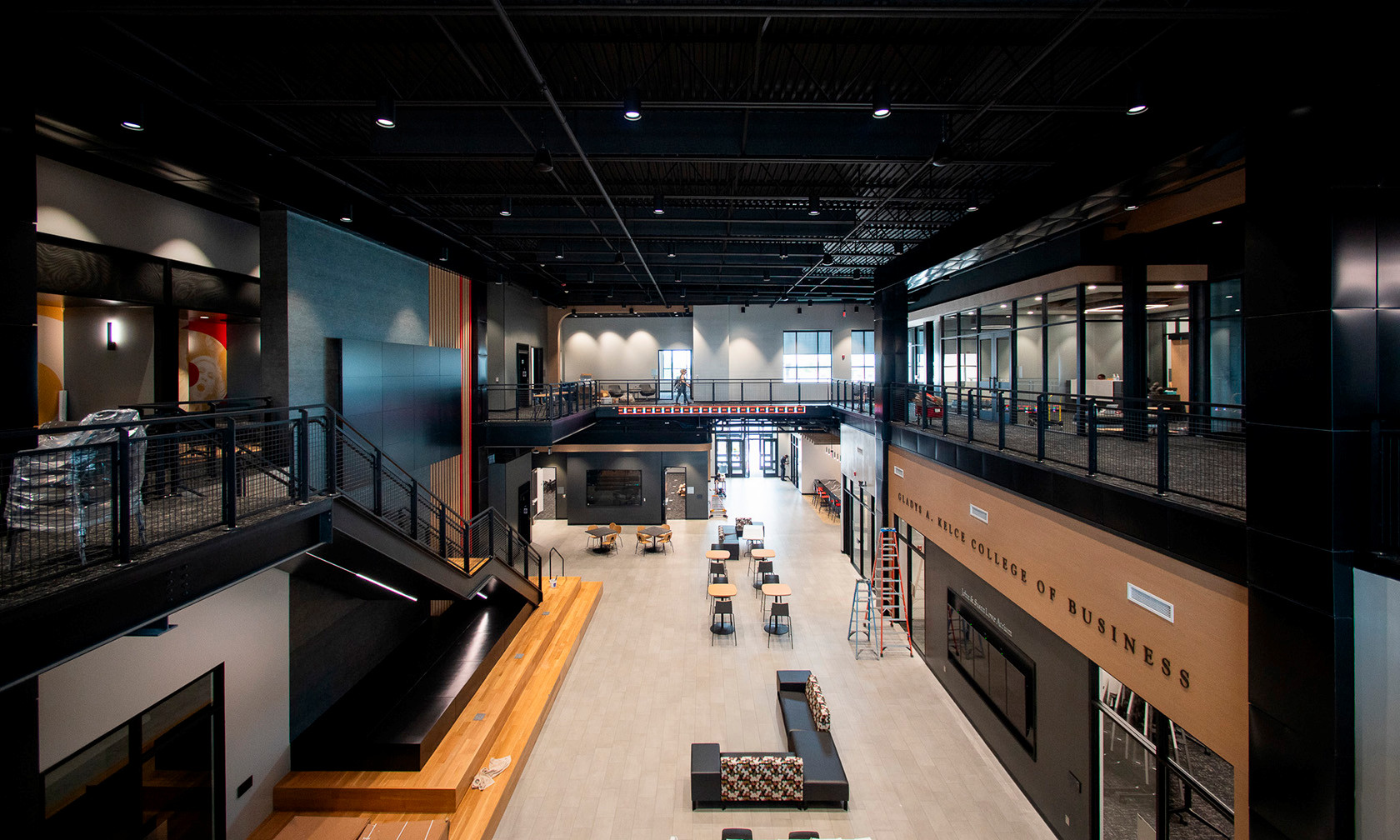
The new home to the Kelce College of Business, built at Third and Broadway, addresses those challenges while providing more than 60,000 square feet of modern learning, collaboration, and engagement space.
Designed to complement the historic architecture of downtown Pittsburg, the building features cutting-edge technology, flexible classrooms, collaboration areas, study spaces, and amenities that support innovative teaching and learning for more than 1,000 business majors preparing for careers that, in many cases, did not exist when the college was founded.
"This building reflects the vision of many leaders, past and present, within our community and this state," said Grimes.
He described the building as more than an academic facility.
"Our students will learn valuable lessons while spending time interacting with our downtown neighbors. Our new home also reflects the best of today's professional design and educational technology," Grimes said. "Classrooms, study spaces, collaboration areas, were all built and equipped specifically to foster learning and to assist us not only in preparing students to enter today's workforce, but also for jobs of tomorrow."
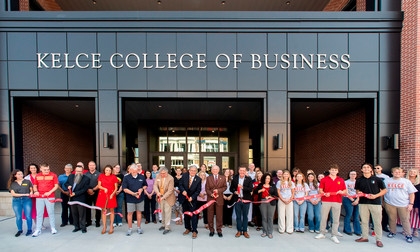
Past university presidents Tom Bryant, Steve Scott, and Dan Shipp, and former vice president Shawn Naccarato, were recognized during the ribbon cutting ceremony for laying the initial groundwork for such a project.
"We have built on your legacy. Thank you," said Vice President for Advancement Kathleen Flannery.
Key donors and partners who helped make the project possible were recognized, including All Aboard Foundation, Watco Companies, the Webb and Lundy families, the Crossland family and Crossland Construction, and John (BBA '81) and Susan Lowe (BBA '81), whose lead gift launched the project in 2015.
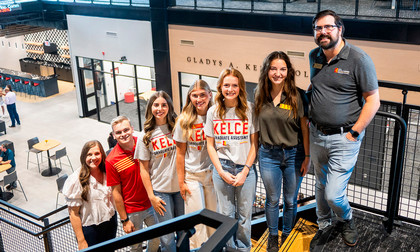
Throughout the building, donor names are displayed in recognition of their support. A prominent portrait of Gladys Kelce, for whom the college is named, overlooks the Lowe Atrium from the second floor.
Alumnus Mat Burton (BBA '98) was recognized for shepherding the project, along with the efforts of many faculty and staff members and city employees who played crucial roles in bringing the vision to reality.
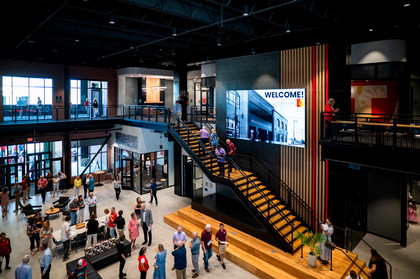
The building's impact already is being felt by students.
Andrew Preston, a junior accounting major who works in the dean's office, said the transition from the former College High building to the new facility has been remarkable.
"Going from the old College High to the new Kelce is an incredible opportunity and I'm so glad I get to be a part of it," he said.
Preston said his favorite feature is the abundance of study and gathering spaces available to students, including approximately 200 seats outside of classrooms where students can study, collaborate, and connect.
"I'm from the Wichita area, but what they've done with this space makes it feel like home," he said.
Assistant Professor of Economics Braxton Gately said one of his favorite elements is the Spigarelli Selling and Behavioral Lab, which is equipped with one-way observation windows and advanced technology for research and focus groups.
"I teach experimental economics, and with most classes we did not have a behavioral lab — this will give them real hands-on experience with that," Gately said. "We are one of very few public institutions that have one of these."
Kansas Regent Blake Benson (MBA '25) said the project demonstrates the broader impact higher education can have on communities.
"Today's project is a great example of that, because today is not just about a new building or two buildings, it's about partnerships. It's a great example of what can happen when a university, a community, business and industry, alumni, donors, and city and state partners gather around a shared vision," Benson said.
The project, he noted, will create opportunities for collaboration, entrepreneurship, internships, workforce development, and economic activity.
"When future business leaders are learning alongside the business community, when a university invests in the heart of its community, everyone wins," Benson said.
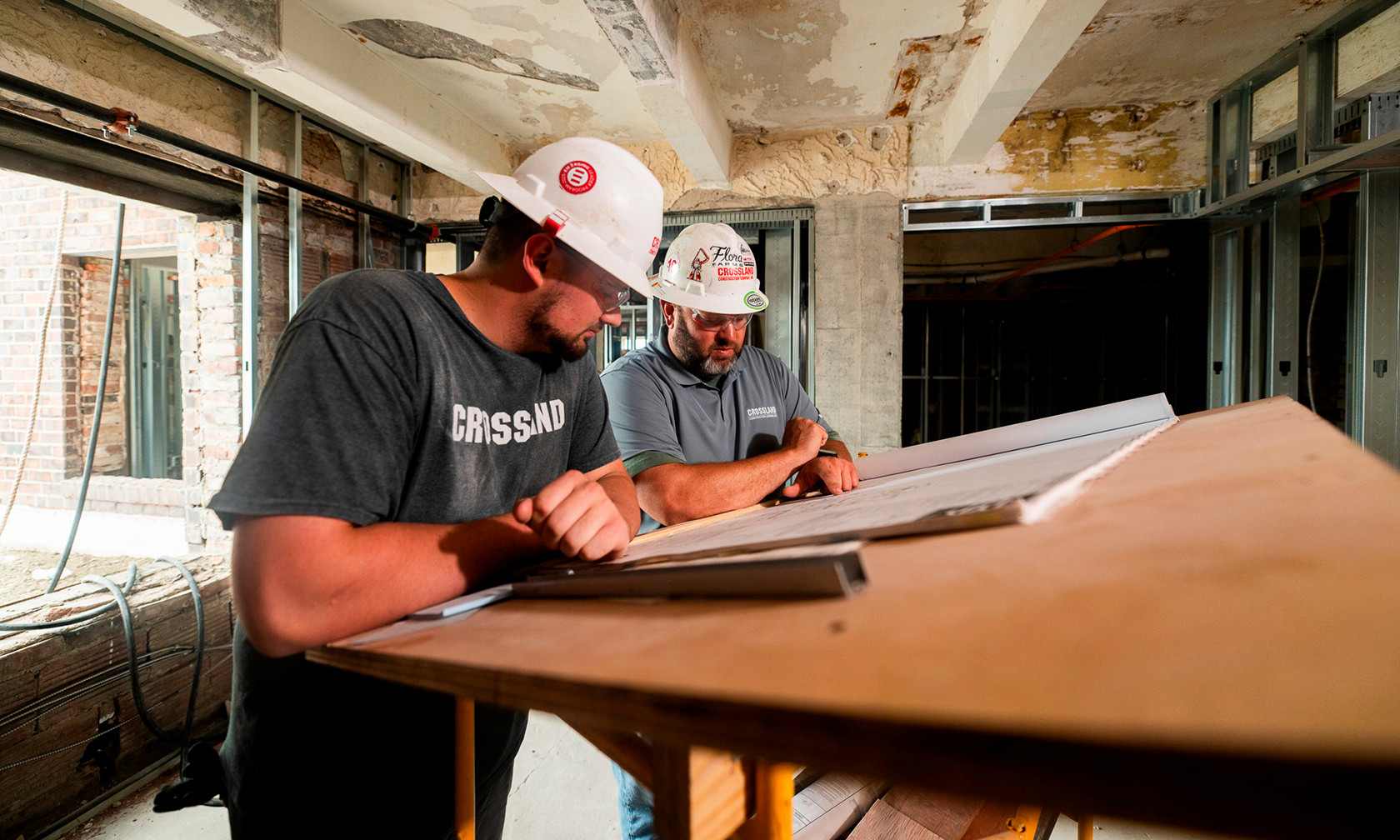
The celebration also included a ribbon-cutting ceremony and tours at the historic Besse Hotel, a landmark that has been restored and repurposed through a partnership involving Pitt State, the Pittsburg Area Chamber of Commerce, private partners and donors, historic tax credits, and a Kansas Department of Commerce Challenge Grant.
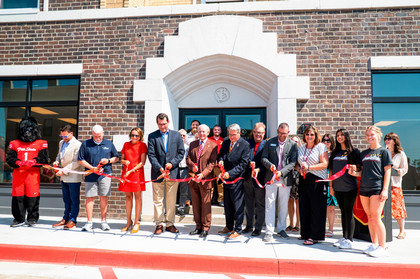
"If these walls could talk, they could definitely tell some stories," Newsom said.
Built 100 years ago through the combined efforts of Chamber members, local investors, business owners, the local newspaper, and a $25,000 contribution from Alexander Besse, the hotel once served as a hub for community gatherings, special occasions, and civic events.
"Just like 100 years ago, this project took a community coming together and believing what was and could be possible," Newsom said. "We're not just reopening an historic building today. We're giving it a new purpose."
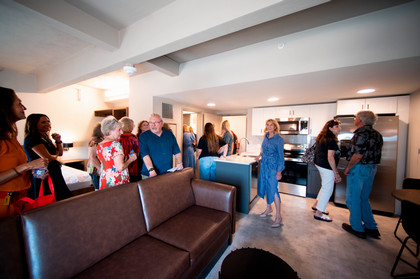
Under the direction of University Housing & Residence Life, the upper floors of the renovated Besse Hotel now feature furnished apartments for 60 students, many of whom will form a living-learning community connected to the new Kelce College of Business.
The historic ballroom has been given new life in the form of a common space for students as well as a separate room equipped as a laundry facility.
A grand piano in the lobby is in tribute to Besse, who mortgaged his grand piano and other holdings to come up with a contribution to move the hotel project forward.
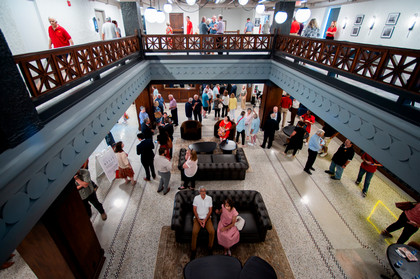
The first floor will be open to the public and house the Center for Reading, the Small Business Development Center, and ConnectEd PSU.
The Center for Reading conducts testing and provides support for youth with dyslexia and other reading challenges. The Small Business Development Center offers a range of resources and assistance to entrepreneurs and small business owners throughout the region. ConnectEd PSU bridges the gap between K-12 and higher education.
Prior to redevelopment, noted City Manager Daron Hall, the hotel had stood boarded up for years and attracted vandalism.
"But to see what it is today, when you go inside, I'm really speechless on this one," Hall said. "It looks like a boutique hotel."
For many attendees who marveled at the tile floor and other carefully preserved historic elements, the Besse Hotel's restoration carried personal meaning.
Alumnus Ken Webb (BBA '69) recalled visiting the hotel when community organizations gathered there and a restaurant operated inside. This fall, his grandson will live on the fifth floor as a Pitt State student.
"It's amazing, it's fantastic, it's wonderful," Webb said.
Others shared memories of milestone moments in the building. Peter (BA ‘66) and Jo Farabi (BSEd ‘66, MS ‘69, EdS ‘90), held their wedding rehearsal dinner at the hotel in 1966. They praised the restoration.
"I'm just glad they saved it," Peter said. "They've modernized it, they've preserved it, it looks great. And it still feels historic."
To enhance connectivity between campus and downtown, a Gus Bus shuttle will provide free transportation for students, faculty, and staff, operating continuous loops from campus and the Research Park to the Besse Hotel and Kelce College of Business.
"This project isn't just about a few buildings," Newsom said. "It's about creating energy downtown, creating opportunities for entrepreneurs and students, and to continue to make Pittsburg a place where people want to live, work, learn, and invest."