
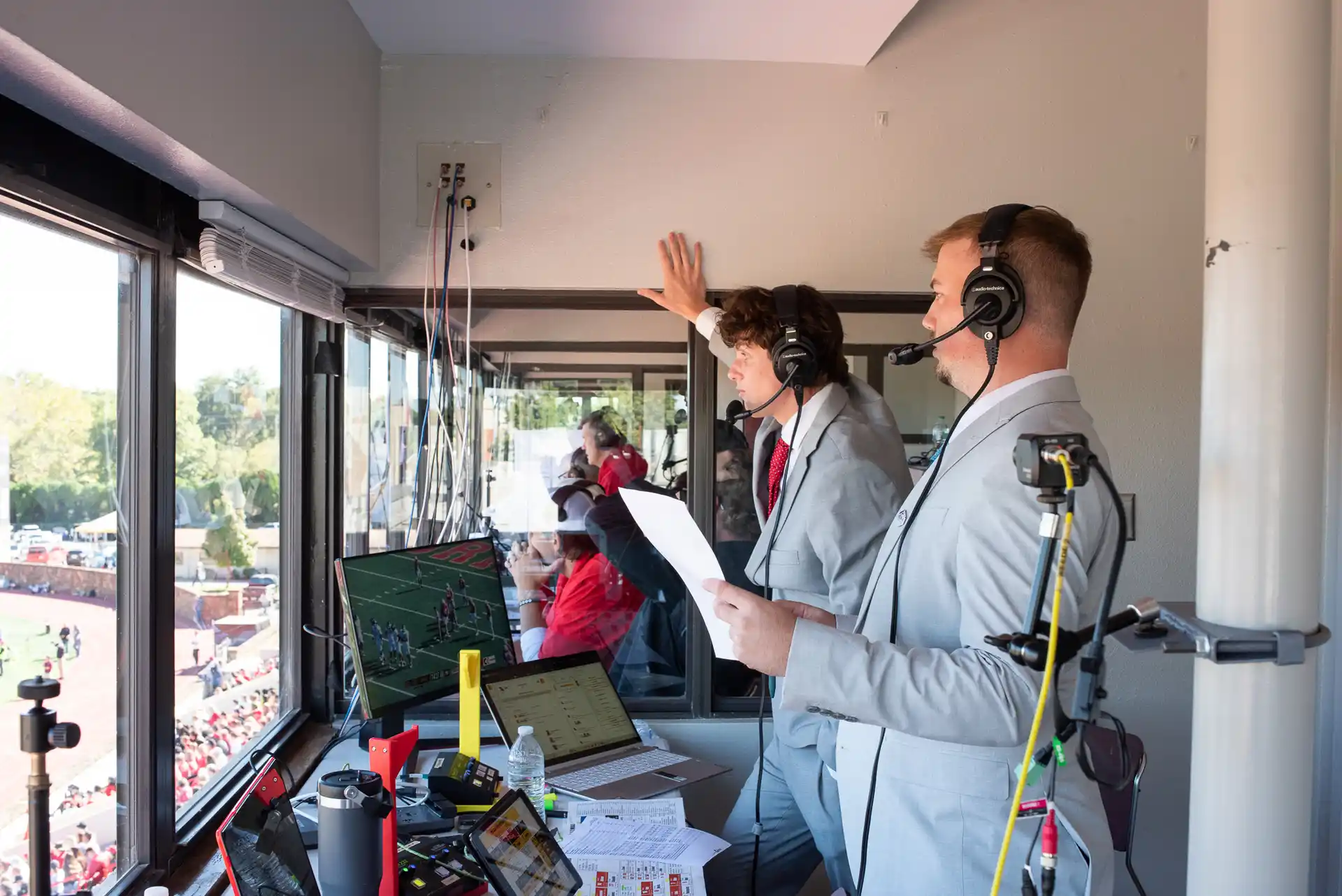
Hours before kickoff or tipoff, while most fans are just beginning to think about the game, students in Pittsburg State University's Communication Department already are at work.
They're setting up cameras, coordinating graphics, reviewing rosters, preparing storylines, and testing equipment. By game time, they're producing live broadcasts of Gorilla Athletics events that reach audiences across the region and beyond.
The quality of those productions is earning national recognition. Last spring, students in the Sports Broadcasting II course were named finalists for a National Media Production Award for Best Live Sports Broadcast for their coverage of the Pittsburg State versus Fort Hays State women's basketball Game of the Week on Feb. 21, 2026.
Last week at the 2026 National Student Media Convention, they brought home a first-place win.
But the program goes beyond a trophy and bragging rights, students say.
Experience from Day 1
Each semester, students majoring in Communication-Media Production gain valuable hands-on experience producing broadcasts for football, basketball, volleyball, soccer, baseball, and other athletic contests at Pitt State.
Under the guidance of Professor Troy Comeau, students rotate through nearly every role in a live sports production, from camera operation and replay to directing, producing, and play-by-play announcing.
The result: students who graduate ready to step into professional roles in broadcasting from coast to coast.
"It's completely student-run," said senior Brayton Lind, a co-producer of the sports broadcast team. "That's why I chose going here over a larger university. At Division II, you get to experience commentating games and running the real production for the mainstream. At larger universities, they have teams that come in from commercial stations that do it and they get paid."
"I don't think there is any better place you can come in and get firsthand experience starting your freshman year. It's amazing."
For Lind and fellow co-producer Collin Hammons, the experience has done more than build skills. It has helped define their careers.
From passion to profession
Lind, who will graduate in December, grew up in Leroy, Kansas, and graduated in a class of just 10 students. Sports broadcasting was woven into his life early. His father worked as a DJ and announced high school football games.
Lind soon was getting his own opportunities behind a microphone.
When he transferred to Pitt State from Allen Community College, he combined his love of sports with broadcasting.
"This was the best decision I've ever made when it comes to school and my future career," he said.
As a student, Lind already is working in the field, thanks in large part to connections made while at Pitt State.
"I landed a position as sports director for Ad Astera Radio after I introduced myself to representatives from the station at the Kansas Association of Broadcasters awards ceremony and shared examples of my work,” he said.
Three days later, they offered him a job.
Finding the right path
For Hammons, who is 26, the path to sports broadcasting was far less direct.
After graduating from Carl Junction (Missouri) High School, he enrolled at Pitt State and studied marketing before stepping away during the COVID-19 pandemic. He worked full time selling phones, earning a good living but feeling unfulfilled.
When he discovered sports broadcasting as a career option, he began researching opportunities and found Pitt State's program. He reached out to Comeau and quickly received a response.
"It was 100 percent the right decision," Hammons said. "I figured out what I wanted to do in life, and this was definitely the place to do it."
Since returning, Hammons has worked in every production position and now shares responsibility for leading the student crew.
"I never would have thought this was a career option, something I could obtain," he said. "But once I started doing it, and gaining experience here, I absolutely just fell in love."
Learning by doing
The philosophy behind the program is simple, Comeau said: students learn broadcasting by broadcasting.
When Comeau took over the program in 2001, students were recording games and editing video on Sundays.
“The first thing I did was purchase a video switcher so we could switch cameras live instead of recording and editing later,” he said. “I added one new thing each year and over the years, it led to some major changes — replay, graphics, more cameras.”
He requires students to work multiple events each semester, ensuring they gain experience in a variety of positions.
"Dr. Comeau knows you can't just learn about broadcasting in a classroom," said junior Natalie Crumpler, who transferred to Pitt State this year from a community college.
Crumpler grew up in Exeter, Missouri, and dreamed of working in sports.
"I enjoy sports, and I fell in love with communication at my community college," said the former softball player. "I learned Pitt State has a really good communication department, so it was a no-brainer."
This fall, she reached a major milestone when she called her first live volleyball broadcast during the conference opener against Emporia State.
Preparing for the assignment meant studying player biographies, reviewing statistics, building call sheets, and learning as much as possible about the teams involved.
"Calling is doing commentating over a broadcast," she said. "You are responsible for creating the story that goes along with what the audience is seeing and letting them in on things about the sport and the players that they might not know."
She admits she was nervous before the match began.
"But by the second set, I started easing into it and felt the flow," she said. "I figured it out and felt more confident by the end."
Now she is scheduled to work additional volleyball matches, soccer broadcasts, and women's basketball games.
"I'm excited now because I got the first one done and survived it," she said. "Next time, I'll improve on it, get up there and relax and make it more conversational."
Ultimately, she hopes the experience leads to a career in sports broadcasting, whether behind the scenes or as part of a creative production team.
Creating opportunities
As co-producers, Lind and Hammons spend much of their time ensuring newer students have the same opportunities they were given.
For a typical football game, the producers arrive about four hours before kickoff — at 10 a.m. for afternoon games and at 3 p.m. for evening games. They coordinate with directors and commentators, oversee setup, assign responsibilities, and manage the production crew throughout the event.
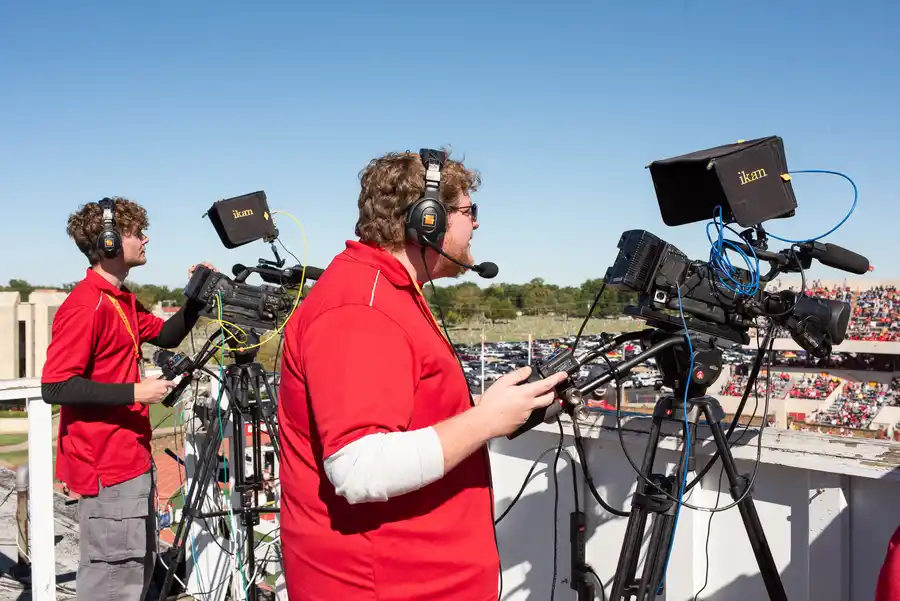
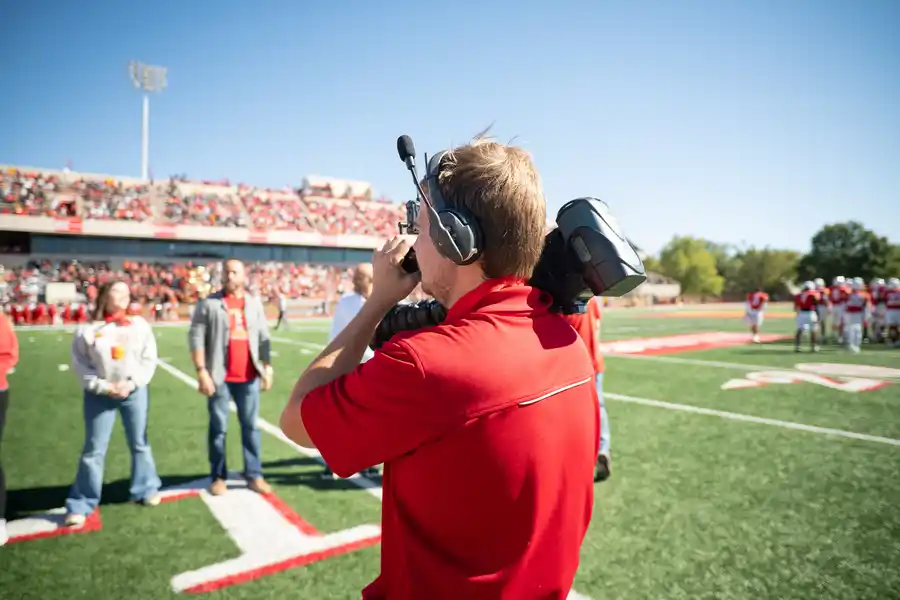
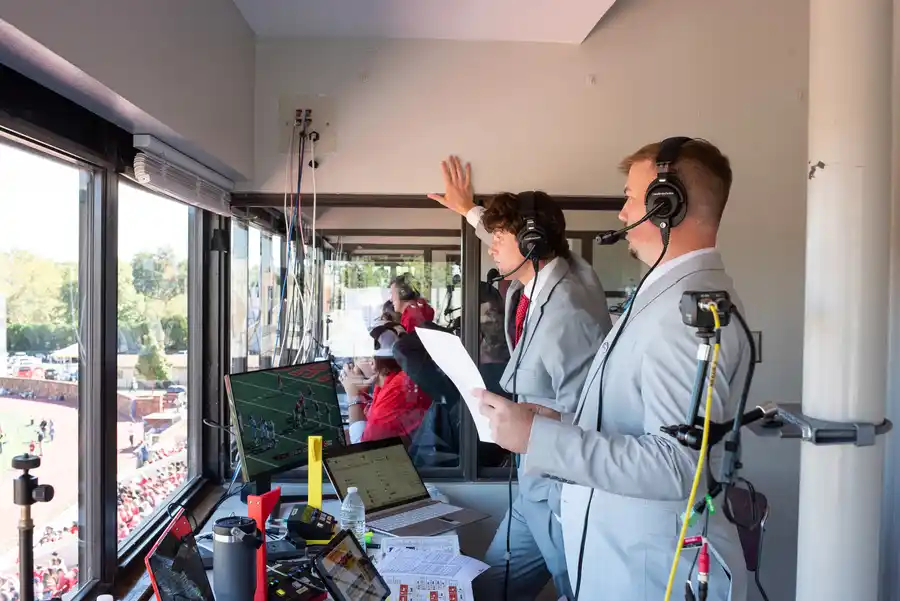
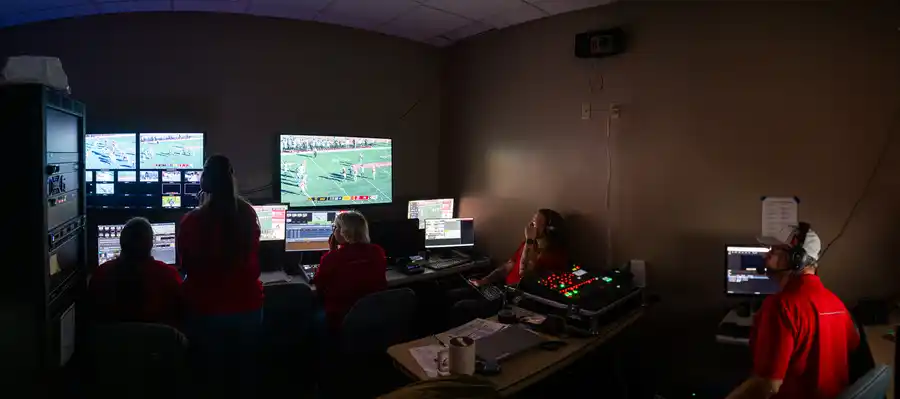
They divide and conquer: At the stadium, two of them are responsible for announcing from the box on the west side, a camera operator captures endzone shots from the Jungletron, two camera operators are in the crow’s nest on the west side, and two camera operators are on the field. From a broadcast control room in the Weede Building, five of them direct cameras, switch between cameras, capture and deliver replay footage, and create and insert graphics.
Afterward, students break down equipment and participate in a postgame debrief to discuss what worked and how they can improve.
It's a long day, but one that both co-producers firmly believe is worth it.
"My job as producer is to get these students the most experience possible in the time they have here," Lind said. "I really love giving people opportunities because I was in their spot when I first got here."
Last year, he helped introduce eight new students to on-air and production roles.
One, freshman Michael Kissel, had no broadcasting experience but quickly earned opportunities through his dedication and preparation. On Homecoming, he got to announce the game alongside Lind.
"It's really exciting to give someone an opportunity," Hammons said. "To be the one to kind of launch them into a new role that is a new step in their life."
That commitment to mentorship has become a defining feature of the program.
Students arrive eager to learn. They leave with résumés full of live productions, professional connections, and the confidence that comes from real-world experience.
Career success
Several Pitt State alums have found success in notable ways in Sports Broadcasting:
- Beth Hamilton (‘03) has shot video for four Olympic Games.
- Derek Crisler ('03) has worked in two stints at ESPN.
- Ryan Bartlett (2023) is a producer at FOX Sports and has worked with ESPN and the NFL Network
- Adrian Herrera ('12, ‘14) owns a production company in Kansas City and shoots packages for major networks. As the Chiefs made back-to-back Super Bowl runs, he interviewed Patrick Mahomes, Travis Kelce, and Andy Reid.
- Ty Goss ('20) is on the sidelines at NFL games managing their pylon cameras. He freelances with CBS Sports, and works for the Denver Nuggets and Colorado Avalanche.
Learn more: