People of Pitt State
Academics
Community
Campus

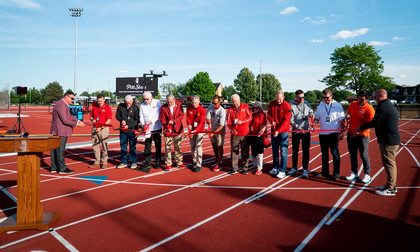
The Russ Jewett Outdoor Track & Field Complex bears the name of a Pitt State alumnus, former student‑athlete, and longtime head coach who built Gorilla track and field and cross country into a national powerhouse during a career that spanned more than three decades.
The dedication ceremony was held as part of the weekend-long 2026 MIAA Outdoor Track & Field Championships Pitt State is hosting.
For more than 35 years, Jewett was head coach of the men’s and women’s track and field and cross country programs, retiring from coaching in 2021. During his tenure, he guided the Gorillas to unprecedented success at both the conference and national levels, establishing Pitt State as one of the premier NCAA Division II programs.
“Today’s dedication is about more than a facility — it’s about honoring a legacy,” said Vice President of Athletics Anthony Crespino. “Russ Jewett’s impact on Pittsburg State athletics, on our student‑athletes, and on this community is immeasurable.”
Finished just in time for spring competitions, the complex is located between the Bicknell Family Center for the Arts and the Crossland Technology Center along east Ford Street. It is south of the Robert W. Plaster Center, which hosts multiple large-scale indoor track and field events each year.

Under Jewett’s leadership, Pitt State reached the pinnacle of Division II competition. In 2016, he guided the women’s team to the NCAA DII Outdoor Track & Field National Championship, and in 2018, he led the men’s team to the NCAA DII Indoor National Championship, marking the first national titles in program history for both.
Jewett’s teams captured 55 conference championships spanning the Central States Intercollegiate Conference and the MIAA. His student‑athletes earned more than 300 All‑America honors and 36 individual national championships.
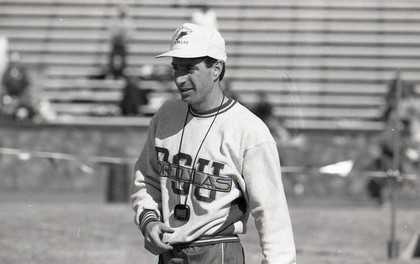
Jewett was named MIAA Coach of the Year 46 times and earned multiple NCAA Division II National Coach of the Year honors, placing him among the most decorated coaches in college track and field history.
Jewett consistently pays homage to those who came before.
“My coach used to talk about standing on the shoulders of giants,” Jewett said in a 2016 interview. “And it’s so true. Doc Weede, Prentice Gudgen, David Suenram — they provided the foundation that has allowed our program to be so successful.”
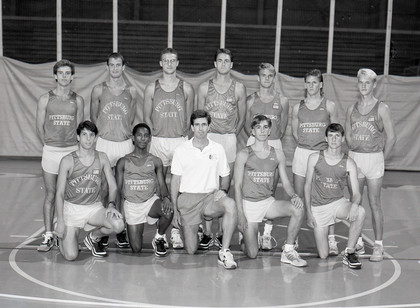
Jewett’s connection to Pitt State began as a student‑athlete. Competing for the Gorillas in the early 1980s, he specialized in the hurdles and the decathlon. He was a three‑time conference champion in the hurdles and earned NAIA All‑America honors in the decathlon in 1982, finishing second nationally at the NAIA Outdoor Track & Field Championships.
He graduated in 1983 with a bachelor’s in Computer Science and Mathematics, a background that later influenced his analytical, data‑driven coaching style. It didn’t take him long to decide on coaching as his career path.
“My head coach at Pitt had such a profound experience on me, almost like a second father,” Jewett said. “That didn’t take me long to come back and commit to exploring collegiate coaching. There really was no looking back after that.”
He met his wife, Janice, at Pitt State, and she went on to become a longtime professor there in Health, Human Performance, and Recreation. Jewett coached their daughter, Sarah, a stand-out student-athlete on the track and field team. Their son, Will, is a professional actor and dancer who recently performed in the hit musical Hamilton.
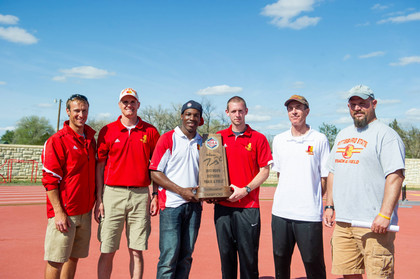
Legendary leadership
In addition to his coaching success, Jewett played a key role in collegiate athletics governance, serving as chair of the NCAA Division II Track & Field Committee.
His contributions in the world of athletics have been recognized with numerous honors, including induction into the Kansas Sports Hall of Fame (2023), the Pittsburg State Athletics Hall of Fame (2023), and the MIAA Hall of Fame (2024). In 2025, Jewett was selected for induction into the USTFCCCA Coaches Hall of Fame, the highest national coaching honor in track and field.
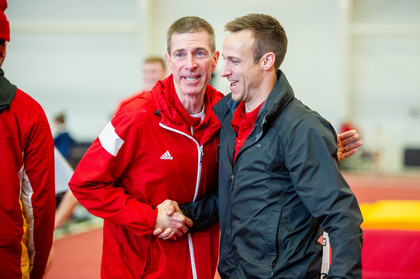
Investment in the community
The Russ Jewett Outdoor Track & Field Complex represents the university’s next major investment in athletics and community engagement. Construction began in Fall 2025.
Led by Mammoth Sports Construction, the complex features an eight lane Beynon track, fencing, storage buildings, a practice area, and seating for up to 1,700 spectators.
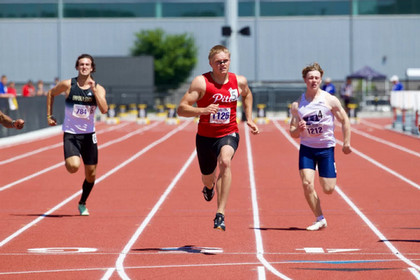
The project is privately funded, with the City of Pittsburg approving funding from its Revolving Loan Fund to support the completion of seating and lighting. These additions will enable the facility to host up to multiday events, drawing tens of thousands of attendees. Already, Coach Kyle Rutledge said the facility’s impact will reach far beyond competition.
“That’s what we’re most excited about — bringing teams and young athletes into this town,” Rutledge said. “We want to get kids excited about track and field, bring people from across the region to Pittsburg, and give the community something they can be proud of.”
City leaders echoed the economic benefits of the project.
“Often, tourism is economic development’s first date with a potential prospect,” said Pittsburg Area Chamber of Commerce President Blake Benson, who noted that hosting major events raises visibility that can lead to broader investment in the community.
According to Michael Davidsson, director of the university's Business & Economic Research Center, the facility could generate up to $3.4 million in new sales, create 37 new jobs, and produce $137,000 in production and import taxes, while activating traditionally slower months for the local economy.
Already, this weekend's MIAA Championship is the fourth event at the complex since it opened in early April, following the annual Jock’s Nitch/Pitt State Gorilla High School Relays, the 18th Annual David Suenram Gorilla Classic, the Pitt State Tune-Up Meet.
A fitting tribute
University leaders said naming the facility after Russ Jewett ensures that generations of student‑athletes, fans, and visitors will understand the foundation on which the program was built.
“Russ Jewett didn’t just win championships,” Crespino said. “He built a culture, mentored countless young people, and elevated Pittsburg State University on the national stage. This facility stands as a lasting tribute to that legacy."