
Academics
Community

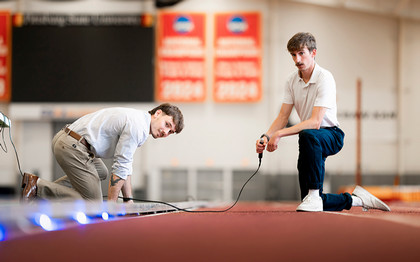
Nate Hinrichs and Tristan Hamilton designed and built a custom electronic pacing light system that allows runners to maintain precise race paces using illuminated guides placed along both the inside and outside lanes of the track.
Their system made its official debut at a recent Pitt State home meet, drawing praise from athletes, coaches, and spectators alike.
Pacing lights — popular at elite and professional track meets — help distance runners stay on target throughout a race by visually guiding them at a consistent speed. The project is estimated to have saved the university nearly $80,000, making it a significant and long‑term investment for the program.
“This is exactly the kind of project we hope for from our students,” said Coach Ben Barrows, who originally proposed the idea. “Their system gives us indoor and outdoor capability at a fraction of the cost and will help us attract more national‑level distance runners to our meets.”
Hinrichs, a member of the Pitt State Track & Field team, brought a runner’s perspective to the project. He noted that pacing is one of the most critical — and difficult — aspects of distance racing.
“Human pacers can put you in the best possible environment to do your best, but even they can get tired or drop out,” Hinrichs said. “This light system guides athletes for the entire race without that inconsistency. It’s been really exciting to see it used in competition and to watch athletes respond to it.”
Hinrichs and Hamilton designed, built, and programmed the system from the ground up as part of their senior capstone course, taught by Professor Clark Shaver. The lights can be programmed to match specific race paces and adjusted quickly for different events, making them useful for both meets and training sessions.
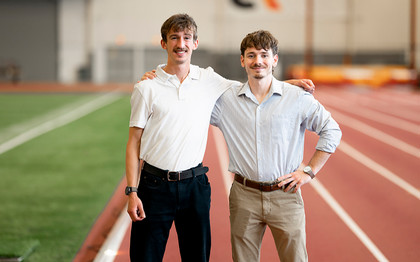
Hamilton said the project reflects the hands‑on nature of Pitt State’s Electronics Engineering Technology program — an aspect that attracted him to the program as a high school senior.
“Our coursework is about two‑thirds hands‑on labs and projects,” Hamilton said. “Being able to work on something that will actually be used after we graduate has been very rewarding.”
Barrows praised the project publicly on social media, calling it a major contribution to the program and a reflection of Pitt State’s student‑athletes and academic strength.
“It’s a great reflection of the outstanding programs and professors here that provide students with hands-on experience and opportunities to prepare them for the real world,” he said.
The system has already generated interest beyond Pitt State. Following its debut, athletes and coaches from other programs expressed curiosity about renting or purchasing similar systems. Hinrichs and Hamilton are exploring the possibility of turning it into a business venture under the working name Track Star Pacing Systems.
After graduation, Hinrichs plans to pursue a career in industrial control systems and automation, while Hamilton is beginning onboarding for a position in flight data testing with a Kansas City‑based security company.
The pacing light system will be used again at Pitt State’s final home meet before nationals, scheduled for May 8–9, continuing to enhance performance opportunities for athletes and the overall experience for fans.
“This is something we can leave behind that will keep helping future athletes,” Hinrichs said. “That’s been one of the coolest parts of the whole project.”
Learn more about Electronics Engineering Technology at Pitt State.