Academics
Community

The program, called AMP-UP — Accelerated Medical Path Undergraduate Program — saves a year of tuition and time for students on the path to becoming doctors and dentists: Their senior year at Pitt State is also their freshman year at Kansas City University medical school in nearby Joplin.
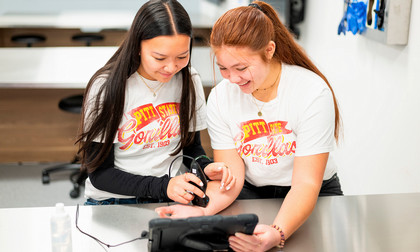
Equally valuable is the preparation they get while at Pitt State. Under the guidance of medical professionals including several Pitt State alumni, AMP-UP students are learning and practicing:
"Being exposed to these experiences is all about building skills and confidence now so when they get to medical school or dental school, they can hit the ground running,” said Professor Mandy Peak.
Peak, who helped create AMP-UP and serves as one of its two lead teachers, calls on a dedicated roster of practicing physicians and dentists — many of them alumni — as mentors.
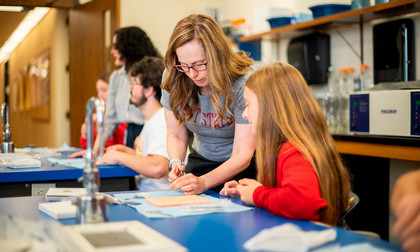
ER physician Dr. Neil Bryan (BS ‘08) of Labette Health is one.
“I didn’t have the chance to do this as a student,” Bryan said. “Being able to come back and teach suturing skills to current students is meaningful to me. It gives them a real advantage as they prepare for medical school, helping bridge the gap between classroom learning and clinical practice. It's a great addition to Pitt State’s Biology/Pre-Med program.”
Access to such experiences is one reason Noah Freiburger, who was the first to earn a seat in the AMP-UP dental program, was drawn to AMP-UP.
He hopes to become an oral and maxillofacial surgeon.
“I applied to AMP-UP to gain early, hands-on exposure to clinical skills and to better understand what a career in healthcare looks like beyond the classroom,” said Freiburger, now a junior. “I’m glad I could do it as an undergrad and not have to wait.”
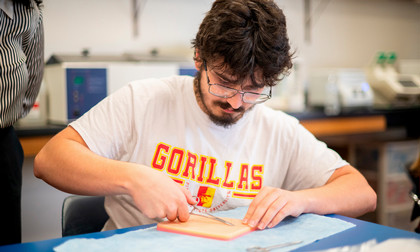
Participating, he said, has been both empowering and motivating.
“I would strongly recommend the program to other students interested in healthcare careers,” he said. “It also has given me peace of mind by helping clarify where I may attend dental school and by offering the security of a saved seat, which has allowed me to focus more fully on my academic and professional development.”
Rylee Ekiss, who plans to become a dentist, found one of the best aspects of the program to be saving one year of time and tuition.
“This opportunity not only saves money but also makes the time needed to complete medical school feel less daunting,” Ekiss said.
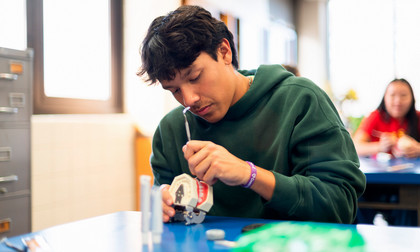
Payton Scharff, a sophomore who dreams of becoming a pediatrician, saw AMP-UP as an opportunity to accelerate the path to medical school while building relationships with students who have shared goals.
"My experience so far has been great,” Scharff said. “I’ve gained valuable knowledge and skills through the workshops and feel more prepared for medical school.”
All of the students found learning directly from practicing physicians and dentists invaluable. Among their experiences:
Program leaders focus on fostering a strong cohort identity in AMP-UP by creating shared experiences for students in and out of the classroom. Students have found that to be an unexpected plus.
“Being able to bond with others who have similar interests and seeing familiar faces in my classes has helped improve my social life,” Ekiss said.
Overall employment in healthcare occupations is projected to grow much faster than the average for all occupations from 2024 to 2034.
According to the Bureau of Labor Statistics, about 1.9 million openings are projected each year.
For dentists, the Bureau of Labor Statistics forecasts a 4 to 5 percent employment growth through 2034, meaning roughly 4,500 to 4,900 job openings annually.
For doctors, estimates are for 86,000 job openings by 2036, with shortages expected in primary care (family medicine) and key specialties like OB/GYN, surgery, and cardiology.
Learn more on the AMP-UP webpage.