Academics

At the same time, they’ve gained experience and skills that will benefit them in their future careers.
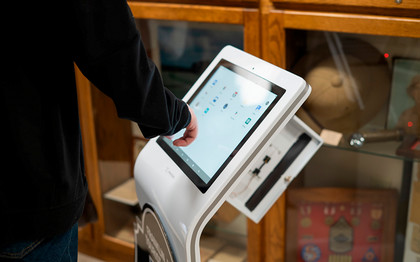
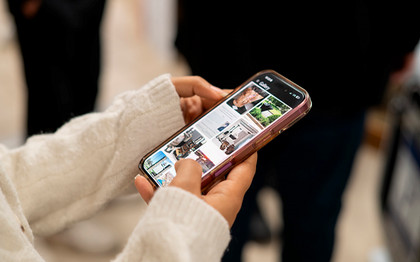
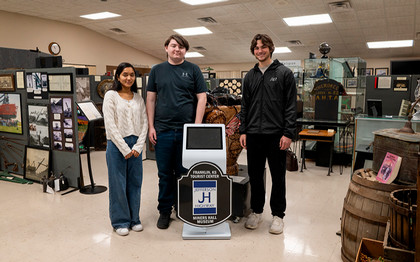
On Wednesday, the group joined museum staff to unveil their work: a fully interactive digital kiosk at the entrance, along with a companion Apple mobile app that extends the museum’s reach nationwide. A Google Play version is in development.
The kiosk was funded through grants from the Pritchett Trust and BMO Harris Bank Trust and Custody.
Together, the kiosk and the app will give visitors — both onsite and remote — easy access to information about Miners Hall Museum, its exhibits, and the region’s rich mining history. They also allow users to apply for membership and make donations directly from their device.
Content is synchronized between the kiosk and the app, ensuring a seamless experience no matter where users are located.
“We may be focused on history, but we also want to appeal to modern visitors. While preserving history, we wanted to move into the future,” said Phyllis Bitner, chair of the museum trustees.
She contacted the Math and Physics Department at Pitt State to explore possibilities with the Computer Science program, and the results surpassed expectations.
“We’re very excited about what they’ve accomplished,” she said. “Our ultimate goal is to better engage visitors and prospective visitors — people who may live several states away who can get a little taste of what’s here through the app."
The student team — Monika BK from Nepal, Carson Stottmann from Parsons, Ben Rangel from Louisburg, and You Kry from Cambodia — worked under Ravindran’s guidance throughout the project.
For them, the experience was a rare opportunity to take classroom learning and convert it into a functioning product for a real client.
“We used a framework called Flutter that we learned in class as juniors,” Rangel said. “The coolest thing is taking what I learned in class to create something real, and seeing it all come together in a way that people can use. Seeing the finished product is rewarding.”
Ravindran said the project required his students to stretch, collaborate, adapt, and implement theory into practice.
“They faced challenges just like you do in a real-world project — things pop up and you must learn to navigate that,” he said.
To sustain the work, the team applied for and received a $2,000 annual credit to host the app on a cloud-based server, ensuring the infrastructure can grow alongside the museum’s needs and that future classes can add to it.
“We can add more features, images, videos — things to make it more robust,” Ravindran said.
Professor Bobby Winters said projects like this have a transformative impact on students.
“In class, students and teachers speak the same technical language, but with a client, regardless of how smart they are, they may not speak that language,” he said. “This was a good exercise in determining the wants and needs of the client in a collaborative way.”
The benefits, he noted, extend far beyond the walls of the Miners Hall Museum.
“They will be further along when they start their careers because of this project,” he said. “It was a valuable experience.”
The computer science program at Pitt State prepares students for a career in a rapidly-changing technology industry. The skills students gain allow them to harness the power and flexibility of Artificial Intelligence, new platforms, and evolving systems to make life better for communities across the globe.
https://www.pittstate.edu/science/programs/computer-science/index.html